Program Overview
Mode of delivery and schedule
Hybrid. One to two evenings per week online and two Saturdays per month during the day (mix of online and in person lab days).
Duration and Dates
480 contact hours over 18 months, part-time
Start date: Week of October 12, 2026
Information sessions: Will be held starting in May 2026.
Information session
Attending an information session is mandatory. Information sessions will be held starting in May 2026. Please click the “Attend an information session” button below to put yourself on our contact list.
Description
This AEC program aims to provide graduates with an additional intervention tool by offering an approach that integrates with those developed during a prior training program in the social services, education, or health sectors.
Students in this program will have the opportunity to make theoretical and practical connections between animal-assisted therapy and different approaches and techniques they have learned throughout their careers. They will learn to integrate their animal-assisted interventions.
The primary goal of this specialized training is to better equip practitioners in various fields, including education, health, and community service. Animal-assisted therapeutical interventions aim to improve quality of life and/or provide therapeutic benefits by focusing on the development and maintenance of the social, adaptation, and learning abilities of the individuals being helped.
Career Perspectives
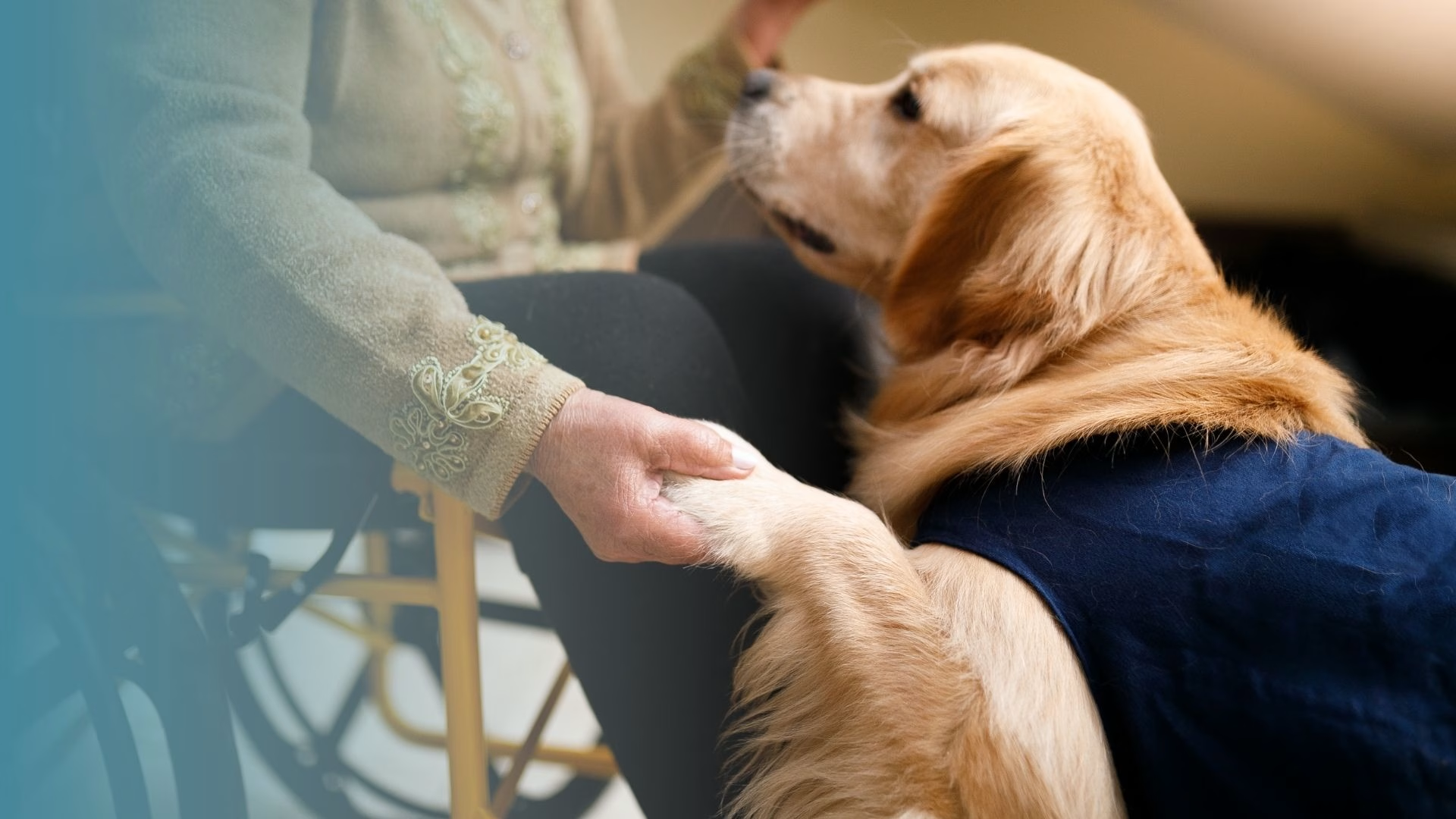
Specialized practitioners in animal-assisted therapy work with clients of all ages in a variety of settings, including educational institutions, school-based childcare settings, early childhood centres, youth centres, residential care facilities, hospitals, and health and social services centres. These clients may include individuals with intellectual disabilities, physical and neurological impairments, mental health disorders, and adaptive or learning difficulties.
The analysis of the work function of special education technicians conducted in 2021 highlighted an increase in intervention work with individuals on the autism spectrum and with elderly clients. These populations are generally very receptive to the presence of therapy and support animals.
351-A64-GR Developing Adaptive Skills through Animal-Assisted Therapy – 60 hours

This introductory course incorporates the animal-assisted therapy approach while developing students’ understanding of clients’ condition from a developmental perspective, in terms of developing or maintaining skills. Topics include identifying characteristics of adaptation issues, exploring the adaptation process in individuals and families, analyzing influencing and protective factors, and action plans for individual needs.
351-A34-GR Animal-Assisted Therapy Techniques and Client Care – 60 hours
This course explores ethical and professional issues and standards in the field of animal-assisted therapy. It examines the scope of intervention, analyzing client needs, and situating zootherapy within broader professional contexts. Topics include ethical conduct, implementing a zootherapy program, safe work practices, and developing personalized intervention action plans.
351-A44-GR Animal Behaviour and Training Techniques – 60 hours
This course focuses on the animal-training component of animal-assisted therapy, introducing students to key concepts related to training and communicating with animals and the clinical use of animals as partners in the therapeutic process. Topics include positive training methods, decoding animal behaviours and communication, evaluating animals for suitability for animal-assisted therapy interventions, and the safe and ethical practices for integrating animals into interventions.
351-A54-GR Fundamentals of Partner-Animal Care – 60 hours
This course explores the fundamental needs of animal-assisted therapy animal partners, focusing on ensuring their physical and emotional well-being. Students will learn to identify species-specific needs, appropriate feeding methods, and practices for ensuring the animal’s health. Topics include animal developmental stages, hygiene, health care, and ethical considerations in animal-assisted therapy interventions.
351-A15-GR Integrative Approach to Animal-Assisted Therapy – 75 hours
This course focuses on integrating and applying previously acquired skills in animal-assisted therapy, through the design and implementation of therapeutic activities. Students will learn to assess client needs, select appropriate intervention methods, and adapt the environment to meet the needs of the activity. Topics include multidisciplinary collaboration and the intervention triad.
351-A1B-GR Integrative Project in Animal-Assisted Therapy – 165 hours
This final course focuses on designing and implementing an integrative animal-assisted therapy project, integrating and applying all previously acquired competencies. Students will plan, carry out, and evaluate a therapeutic activity plan, creating for specific client needs. Topics include ethical practice, project management, clinical use of animals in animal-assisted therapy, and administrative responsibilities. This course involves supervised fieldwork, giving students practical experience in real-world settings, while developing professional autonomy.
Admission Requirements
There are ministerial requirements and there might be specific requirements for each program. Please make sure to check all of them.
Please note that Applicants will also be asked to provide proof of one of the following:
- Canadian Citizenship
- Permanent Residency
- Permanent refugee status (must hold a valid study permit)
- Valid Student Visa
Ministerial Requirements
Applicants must have a Secondary V diploma or equivalent or have acquired knowledge and skills deemed sufficient by the College for potential success in the program. More specifically, they must show proof of:
- A Diploma of High School Studies OR
- A College Diploma or a University Degree OR
- A partial high school program, coupled with a recommendation from a current or former employer that you would benefit from pursuing your education at the post-secondary level.
And
The applicant must meet one of the following requirements:
- Have interrupted studying full-time for at least two consecutive terms or one school year OR
- Be covered under an agreement between the college and an employer, or benefiting from a government program OR
- Have completed at least one year of post-secondary studies over a period of one year or more OR
- Hold a Diploma of Vocational Studies (DVS/DEP)
Program Specific Requirements
- The applicant holds a DEC or an AEC in Special Education Techniques, Special Care Counselling, Early Childhood Education, Criminology Intervention, Social Service, Social Work, or a DEC in Nursing.
OR - Training deemed to be equivalent by the institution.
Technical Requirements
Requirements to take part in the instructor-led virtual classes
To take part in the instructor-led virtual classes, you will need a personal computer with these minimal requirements:
- PC compatible with Windows 10
- Webcam with microphone
- High-speed internet (at least 2 megabits)
Although not an admission requirement, please see the new French-language requirements for certification for AEC programs in English.
Note: This program is offered through a partnership with the Cegep de Granby.
How to Apply
Here are the steps to follow to apply to a program:
1. Attend an information session
The first step is to sign up with the “Attend an information session” button at the top of this page. During the information session, which might be in a group or individually, the pedagogical counsellor for the program will explain in detail the admission requirements, how the program works and the application process.
2. Submit an Application for Admission
After attending an information session, a link will be sent to you to access the Omnivox online application for Champlain Saint-Lambert. Using the “Submit an Application for Admission” button, select the semester in which you would like to register, the Pathway (Continuing education or RAC), the program in which you would like to register and your legal status. Continue to follow the instructions and provide the required information.
3. Upload required documents
Here is the list of required documents you will be asked to upload:
Status in Canada documents, meaning one of the following:
- Québec birth certificate OR
- Canadian birth certificate AND a valid Quebec RAMQ card OR
- Canadian citizenship card/certificate AND a valid Quebec RAMQ Card OR
- Permanent resident card AND a CSQ (Certificate of Selection of Quebec) or a valid Quebec RAMQ card in the event that you did not receive a CSQ
Schooling documents (Secondary school, college, or university certificates and transcripts for the highest level of schooling completed, plus any other certifications relevant to the program)
4. Await admission verdict
Once you have submitted all required documents, no further action is needed from you. Our admissions team will be reviewing your application, and we will contact you by email as soon as the admission verdict is available. We will also contact you by email should our admissions team require additional documentation or information before an admission decision can be made.
Should you have any questions after submitting your documents and completing your application, please do not hesitate to contact the Continuing Education Department/your program’s dedicated administrative support staff member.
Costs
For more information on the fees for residents and non-residents of Québec and international students, please click here.